Who he was
Life
Reiner Michelfelder (1906–1985) — a visionary moving between art, photography and experiment.
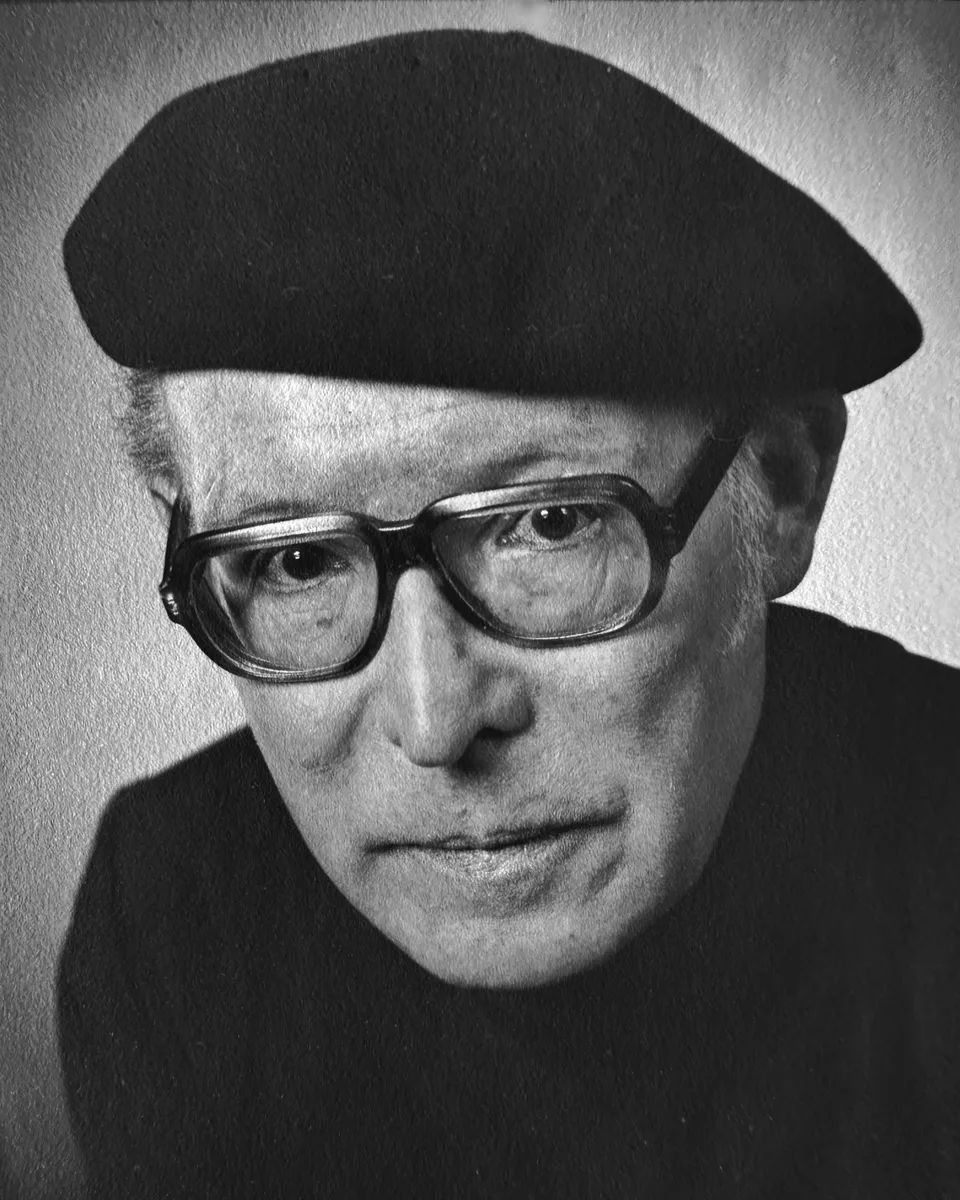 Reiner Michelfelder
Life · 1906–1985
A Life in Light
Some artists hold a mirror up to their age. Others are far ahead of it. Reiner Michelfelder belonged, without question, to the second kind.
Born on 17 August 1906 in Villingen in the Black Forest, he showed early on an extraordinary union of technical understanding and artistic imagination. After his schooling at the Wilhelmsoberrealschule in Stuttgart, his Abitur in Offenburg and his studies at the Technische Hochschule Stuttgart, his path led him into the world of design and the fine arts.
In 1954 Michelfelder settled in Kornwestheim as an independent artist, where he lived and worked until his death in 1985. Over the decades he built an œuvre there that consistently resisted every category. He was at once photographer, draughtsman, painter, advertising designer, exhibition designer and interior designer. His work moved between art, science, technology and design. His chief concerns included experimental photographic art, graphic metamorphoses out of the third dimension, modern patterns for textiles and architecture, and later large-scale projects of art in architecture.
Michelfelder became known above all for his “Ars Dynografia” — a form of experimental photographic art he developed himself. Long before digital image editing or artificial intelligence existed, he created works that still feel astonishingly modern today. In his self-built studio he combined mirrors, prisms, lenses, light sources and apparatus of his own devising into an entirely new visual language. Every work began with an idea and his own graphic source forms — drawings, line grids, dot patterns. Much of it emerged through experiment, some by chance; as his mastery grew, Michelfelder steered the forms, rotations and gradations of light arising within the optical system ever more deliberately.
His creative process was a long journey of many stages and demanded extraordinary precision. Images took shape over hours of work, their outcome often revealed only after developing and fixing; frequently a result served again as the source material for the next stage. A single error could undo an entire day's labour. The variety and quality of the works Michelfelder left behind are all the more remarkable for it.
The opening of a long series of exhibitions came in 1969 with the show “impression 69” at the Bizerba works in Balingen — a resounding success with over 5,000 visitors in a single weekend, which laid the foundation for everything that followed. In the late 1960s and early 1970s his work drew attention well beyond the region. His works were shown, among other places, in the Carl Zeiss Hall in Oberkochen, the Hindenburgbau in Stuttgart, the Musée d'Art et d'Histoire in Fribourg, and in Bern, Bad Hersfeld, Ludwigsburg and Bad Mergentheim. Specialist journals honoured his work with cover stories and extensive features.
For all this success, Reiner Michelfelder always remained modest. Promoting himself interested him far less than advancing his ideas. His drive was not fame but curiosity — the search for new forms, new perspectives and new possibilities of design.
Today his works reach us like messages from a future he had foreseen decades earlier. They reveal an artist who, with technical mastery, scientific curiosity and boundless imagination, created pictorial worlds that have lost none of their fascination to this day.
This exhibition honours more than the work of an exceptional photographer and designer. It tells the story of a creative visionary who shaped his own analogue art form out of optical experiments, technology and imagination — and whose work, more than four decades after his death, has lost nothing of its relevance and radiance.