The Technique
What is a dynograph?
A dynograph is a unique photographic piece that conjures a powerful sense of movement and depth. To create it, Reiner Michelfelder developed an optical system of his own: he led hand-drawn source forms through glass bodies, mirrors, prisms and projections until the play of reflections gave rise to entirely new structures — which he fixed photographically in the darkroom. So that optical transformation sets into image.
The name joins the Greek dynamis (force, motion) with graphein (to write, to draw): a writing made of movement. What Op art otherwise paints, Michelfelder produced through an optical system of his own — glass, mirrors and prisms — and held fast photographically, decades before any digital image editing.
The creative process
In four steps to the image
- 01
The Vision
It began with an idea — and with his own graphic source forms: drawings, line grids, dot patterns. The composition, rotations and reflections had to be fixed in the mind's eye before the first move was made. Without them, the variations would have been all but infinite.
- 02
The Optical Transformation
In his own laboratory he fed his source forms into an optical system: glass bodies, mirrors, prisms and projections. By altering angles, distances and optical relationships, entirely new structures emerged — each step a creative decision.
- 03
The Development
Once an image took shape within the optical system, he fixed it photographically. Much of it appeared only hours later, during developing and fixing — some of it by chance, which he steered ever more deliberately as his experience grew. Often a fixed negative served again as the source for the next transformation. Every move had to be right; a single mistake could undo an entire day's work.
- 04
The Unique Piece
What remained could not be reproduced: a single sheet in which optical transformation has set into image, carrying a powerful sense of movement. Each work was completed in black and white; colour versions were made later, where desired, in professional laboratories. Every dynograph is an original.
The Place
Studio & darkroom
Michelfelder pursued paths that almost no one had taken before him in photographic terms; his experiments moved at the very limits of what was then possible. To that end he built his own studio and darkroom — with apparatus that simply could not be bought anywhere.
He was far more than a photographer: a draughtsman, painter, exhibition designer and commercial artist. If one wished to name a weakness, it would be his modesty. Self-promotion was foreign to him; he always placed the work above his own person.
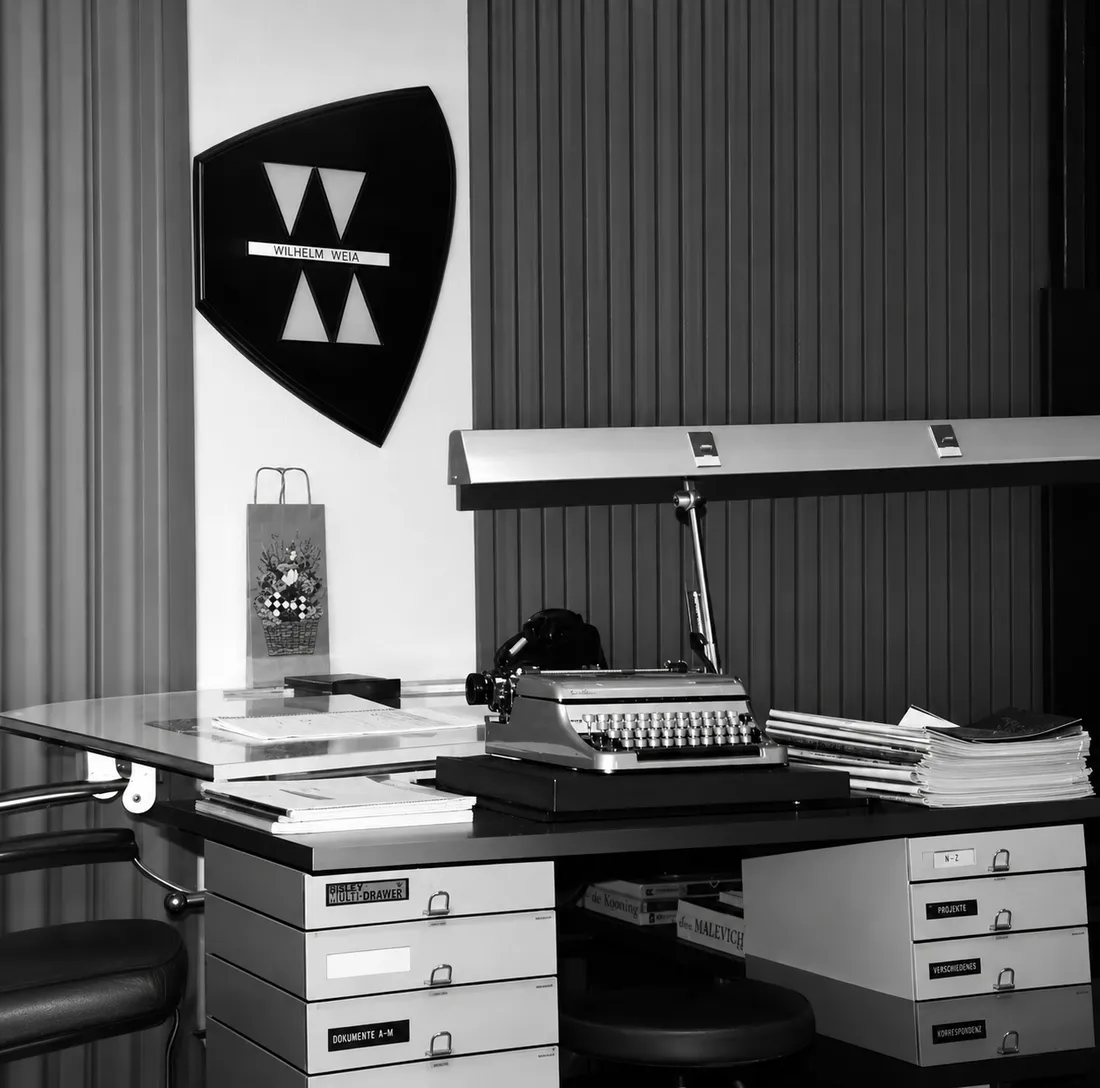 Studio
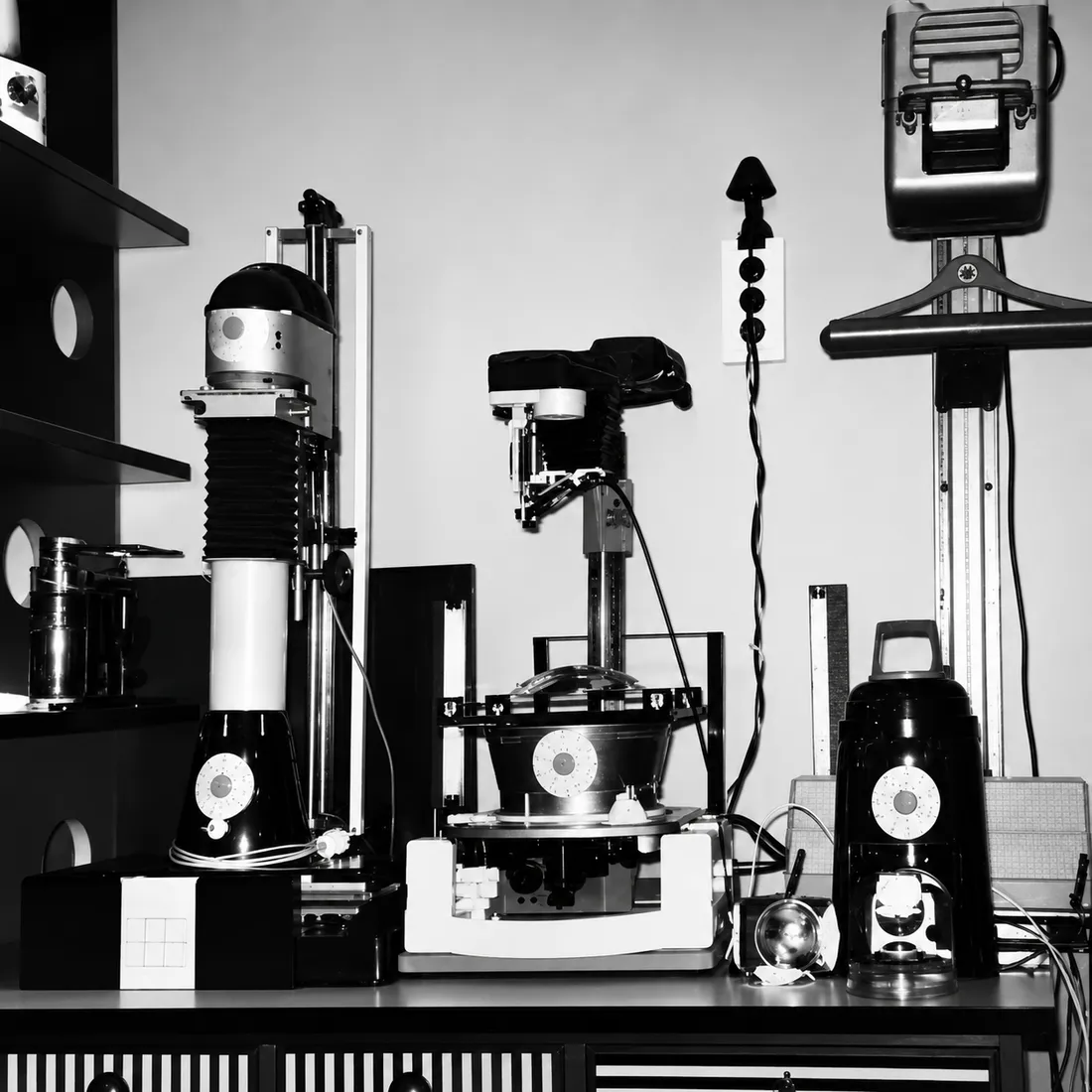 Apparatus
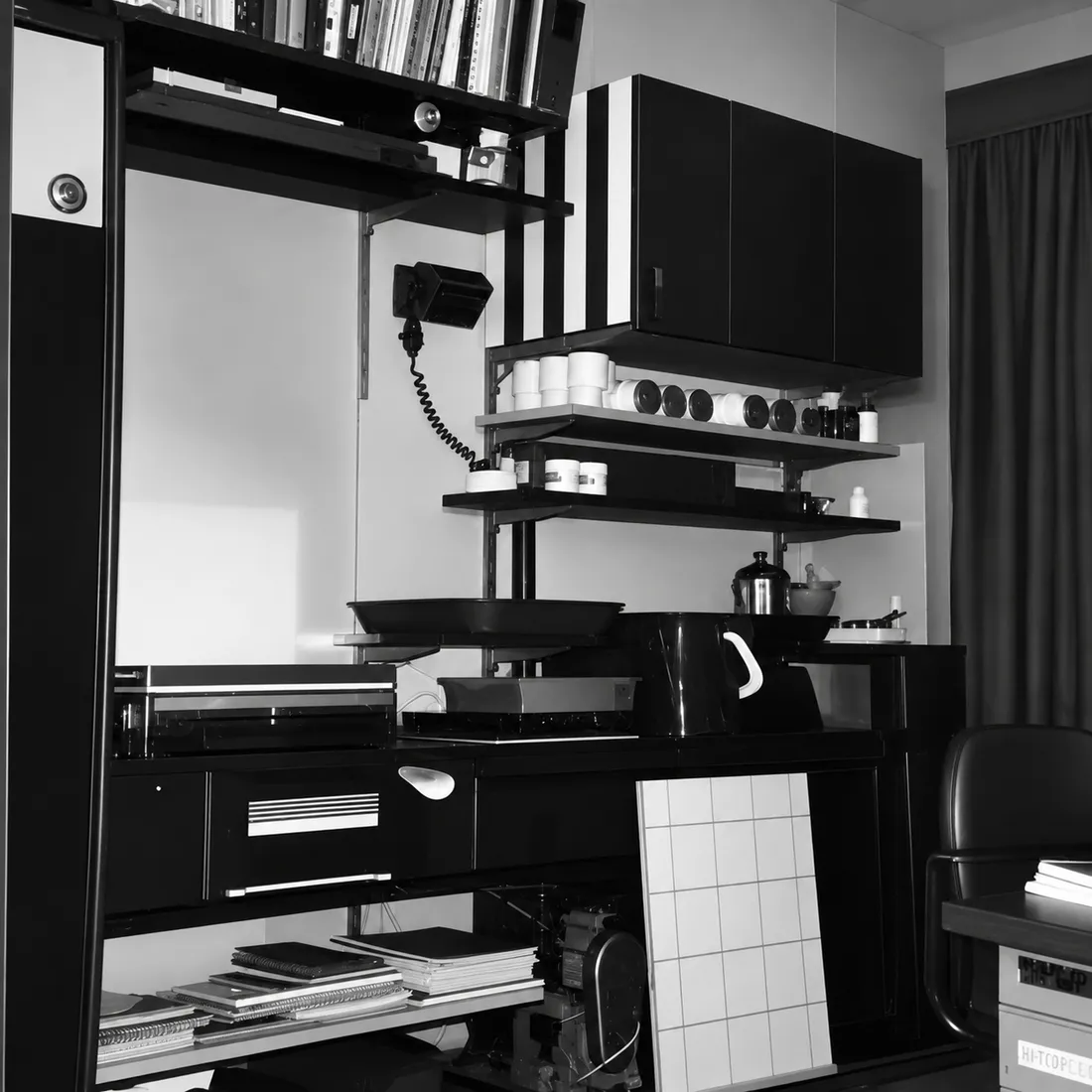 Darkroom
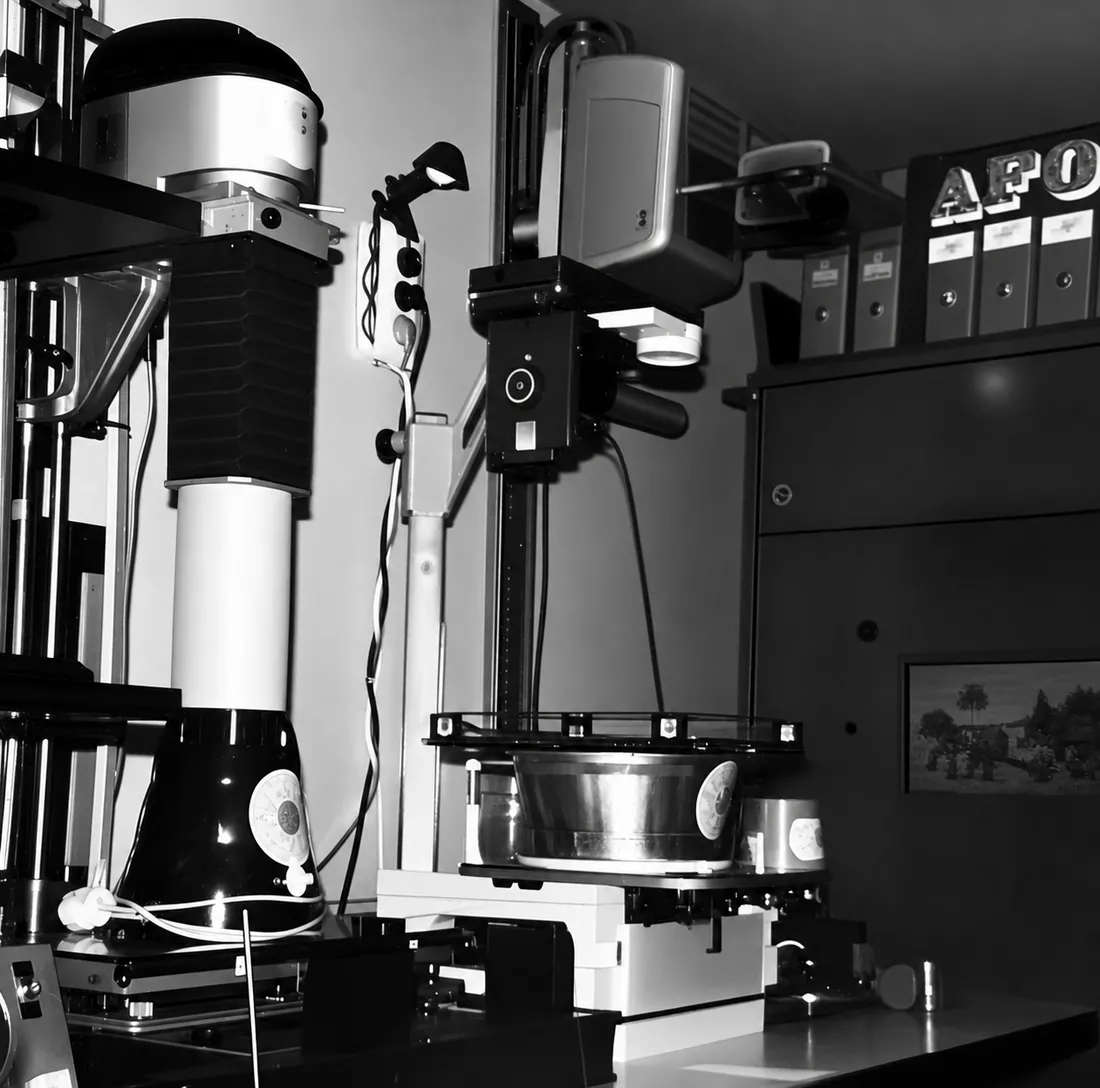 Enlarger
Michelfelder's self-built studio and darkroom
Further development
More than photographs
Michelfelder did not regard his images as photographs alone, but as visual structures — forms that could be carried onward. A fixed negative or transparency could re-enter the optical system and yield a further stage of the same image; some works passed through several such transformations.
From the resulting structures came designs for publishing and graphic design, for textiles and ceramics, for architecture and packaging. That is why the catalogue holds serigraphs, majolica stone slabs and glass works alongside the photographs.
Why the original matters
The trace of the hand
Today, the visual results may in part be recreated with digital tools or artificial intelligence. Yet the making of these works was a singular process, uniting knowledge, imagination, the courage to experiment and consummate craftsmanship.
Just as a historic sculpture can now be milled from stone by machines while the original nonetheless remains something singular, Michelfelder's works too carry within them the decisions of his hand and the story of their making. It is precisely this authenticity that gives them their enduring artistic worth.